We train RWKV models to drive the 231 real tools of our assistant Gungnir. This post documents a result we did not expect this early: after a single epoch of state-tuning, at a GPU cost of $0.53, our local 2.9-billion-parameter RNN reaches the exact same overall score as a cloud model ten times its size on our benchmark. And the result replicates byte for byte.
Everything below is verifiable: the benchmark, the tool schemas, the raw generations, the scripts and the cryptographic fingerprints of the models are published. Hostile reviewers are welcome.
An agentic assistant receives a natural-language request and must decide which tool to call. On Gungnir that means choosing among 231 functions, many of which look alike: archive versus delete a card, search email versus search the web, five variants of cost analytics. It must then fill the required arguments without inventing any. And when the user simply says thanks, the right answer is to call nothing at all.
Large cloud models do this well. Our bet is that a small recurrent model, runnable on ordinary hardware, can learn the same trade. The stakes go beyond our product: an RNN has no KV cache, its session state stays constant in size no matter how long the conversation runs, which changes the economics of serving agents locally. We had already explored this architecture family for document retrieval; here we go after the action decision itself.
We built an 82-case judge over Gungnir's real tool schemas, split across five categories: hard selection (23 near-duplicate traps, the archive-versus-delete kind), argument filling (22), simple selection (18), abstention (17 cases where no tool should be called) and multi-step (2).
Three precautions structure this judge:
The judge, the 231 tool schemas, the scripts and the raw outputs are published in the benchmark repository (link at the end), alongside Gungnir's code, which is itself open.
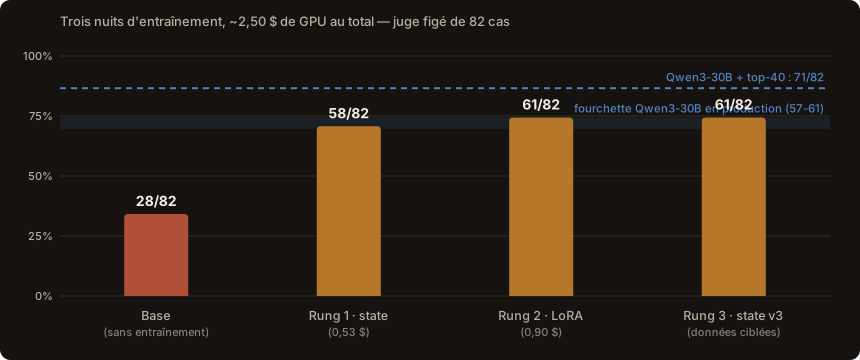
The target is qwen/qwen3-30b-a3b-instruct-2507, a 30-billion-parameter mixture-of-experts with a strong function-calling reputation, queried through OpenRouter in its normal mode: all 231 raw schemas in context. Score: 58/82 (70%), with perfect abstention (17/17).
Our RWKV pipeline is different, and openly so: a retriever (a 144M RWKV embedder we had fine-tuned for search) shortlists the 40 most plausible tools, measured at 100% recall on this judge, and the model chooses among them. A small model with 4,096 tokens of native context cannot swallow 31,000 tokens of schemas; retrieval is not an optimization, it is the local pipeline's condition of existence. Both systems answer the same 82 queries, each with its own scaffolding.
Along the way, the choice of starting checkpoint taught us a lesson, and it was not the one we thought.
We first measured that the most recent generation published by BlinkDL was significantly worse at tool selection than its predecessor, and concluded that progress of generalist checkpoints is not monotonic on a narrow capability.
Correction, 28 July 2026. That conclusion was wrong, and our own protocol produced it. Peng Bo (BlinkDL) pointed out that our prompt template might be penalising the newer models. So we probed each checkpoint to read back the format it had been trained on, then re-evaluated each one in its own. The newer checkpoints then gain 6 and 9 points, while the older one, used as a control, loses 3. That control is what makes the measurement readable: the gain does not come from the decode settings, it comes from the match between model and format. We were measuring our harness as much as the models. The detail, the probes and the raw generations are in the "checkpoint survey" section of the benchmark repository.
What the correction does not change: on these raw checkpoints, abstention stays at 0/17 and multi-step at 0/2, whatever the format. Syntax was an artificial ceiling, judgement is the real one, and judgement is what the training described below buys.
So the useful lesson is more uncomfortable than the first one: before concluding that a model is bad, check that you are asking it the way it was trained. A benchmark always measures two things at once, the model and the way you question it.
RWKV-7 is a recurrent network: it maintains an internal state that summarizes everything it has read. State-tuning, from the RWKV-PEFT ecosystem, trains only the initial state of each layer: 5.2M parameters out of 2.9B, 0.18% of the model, with all weights frozen. The resulting artifact is an 11 MB file that loads on top of the base model. Think of it as a learned disposition: the model starts every request already configured for the tool-calling trade.
The data: 2,623 examples built on the real schemas, including 312 abstention cases (12%). The construction is verifiable by design: for each tool, a generator produces queries that require it, and the correct call constitutes the label, validated against the schema. Every example reproduces the exact deployment format, retriever top-40 included, sibling tools side by side so the model learns the nuances.
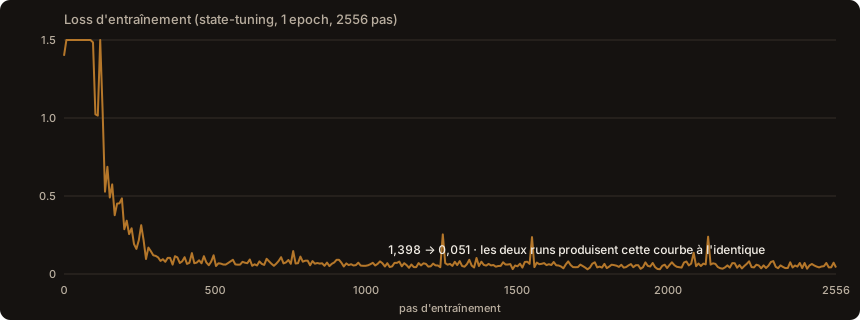
Training: 1 epoch, 2,556 steps, context 6,144, bf16, on an RTX 3090 rented at $0.22/hour. Duration: about 2 hours. Cost: $0.53. The loss goes from 1.40 to 0.05.
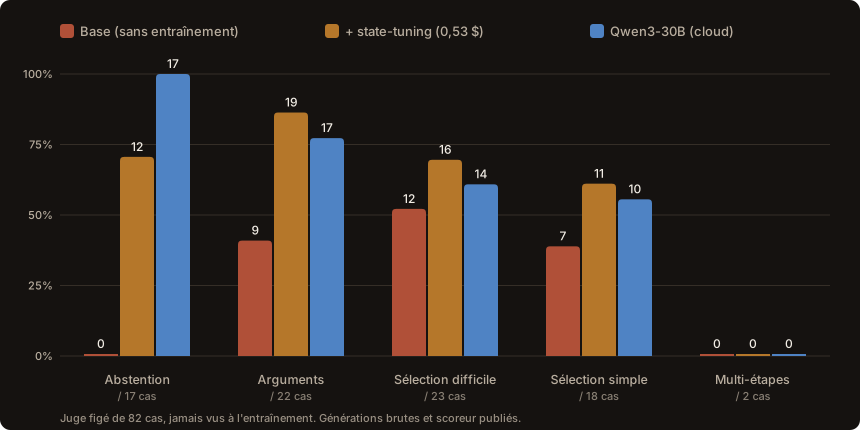
The full table, every model evaluated on the same 82 cases with the same scorer:
| Category (cases) | G1g base | G1g + state-tuning | Qwen3-30B (231 raw) | Qwen3-30B (+ top-40) |
|---|---|---|---|---|
| Abstention (17) | 0 | 12 | 17 | 17 |
| Arguments (22) | 9 | 19 | 17 | 20 |
| Hard selection (23) | 12 | 16 | 14 | 17 |
| Simple selection (18) | 7 | 11 | 10 | 16 |
| Multi-step (2) | 0 | 0 | 0 | 1 |
| Total (82) | 28 (34%) | 58 (70%) | 58 (70%) | 71 (86%) |
Three readings:
The training effect is massive and targeted. From 28 to 58 solved cases. Of the 34 cases where the two versions disagree, the trained one wins 32 and loses 2 (p = 6.9×10⁻⁸, exact McNemar test). Abstention goes from 0/17 to 12/17: the model learned to stay silent. Argument filling goes from 9/22 to 19/22. These are precisely the two behaviors the dataset targeted.
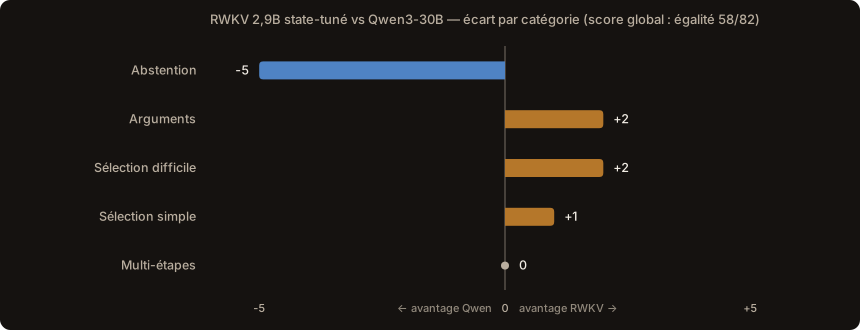
The tie with Qwen is not imitation. On the reference run, both systems score 58/82 yet agree on only 50 cases: each solves 16 cases the other misses. The trained RWKV leads the 30B on arguments, hard selection and simple selection; Qwen keeps the edge on abstention (17/17 versus 12/17).
And the target itself fluctuates. We do not. Four executions of Qwen through the API, all at temperature 0, return 57, 57, 58 and 61 out of 82: the service is not deterministic (large MoE serving rarely is). Our 58 recomputes to the character on any machine. So the parity reads like this: a deterministic score sitting at the center of the cloud model's own run-to-run band.
The format is learned, no longer enforced. The base model needed a formal grammar to produce valid JSON; trained, it no longer does: a single unparsable output out of 82, in free generation. And zero false refusals: on the 65 cases that require a call, the trained model never wrongly declined. The abstention gain did not come at the price of overcaution.
The obvious objection to the table above: our model receives a retriever-sorted top-40, Qwen navigates 231 raw schemas. Does the parity come from the model or from the shortlist? We ran the test before you could ask: same 82 cases, same top-40 per case, sent to Qwen.
Answer: Qwen + top-40 = 71/82 (86%). The shortlist is worth 13 cases to it. Two conclusions, each in its place:
We reran the entire chain on a second machine: full retraining from the base model, then re-evaluation of the 82 cases. Result: 58/82, same categories, same solved and failed cases, and the 164 generations (82 base, 82 trained) are identical character for character. Both trained checkpoints carry the same SHA-256 fingerprint.
The chain is in fact deterministic end to end: zero initial state, fixed data order, greedy decoding. This is not an average with an error bar; it is an exact point anyone can recompute. We prefer that property to a confidence interval.
A result is only useful with a sharp perimeter. Ours:
The night this was written, the second rung of the ladder returned its verdict: a LoRA (r=32, about 1% of parameters, 2 epochs on the same data, $0.90) reaches 61/82 (74%).
| Category | State (rung 1) | LoRA (rung 2) |
|---|---|---|
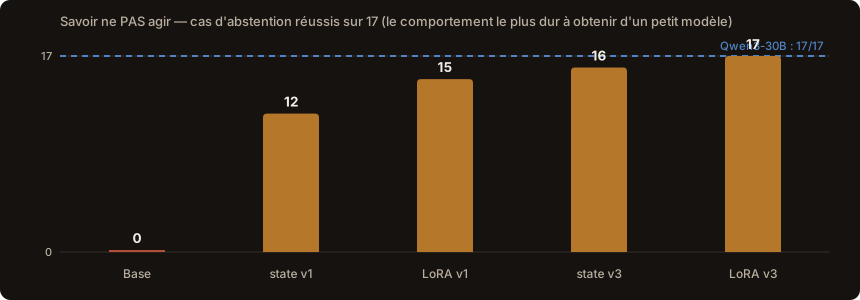
| Abstention | 12/17 | 15/17 |
| Arguments | 19/22 | 16/22 |
| Hard selection | 16/23 | 16/23 |
| Simple selection | 11/18 | 14/18 |
| Total | 58 | 61 |
Three honesty notes before applauding. One, the overall gap with the state is not statistically established (11 cases won versus 8 lost, p = 0.65): at this point, LoRA and state sit at the same level with different profiles. Two, unlike the state, LoRA starts from a random initialization: this run is not byte-reproducible, and its run-to-run variance remains unmeasured. Three, Qwen's equal-scaffold lead remains significant (p = 0.04).
What the profile tells is more interesting than the score: LoRA absorbs abstention better (15/17, only two traps left) and simple selection, but regresses on arguments (16/22 versus 19/22). More adaptation capacity does not dominate everywhere: it moves the trade-off.
The following night, three more experiments, aimed at the identified weaknesses. We added 162 purpose-built examples: 113 "actionable traps" (requests that sound like an action but that no tool covers, the precise abstention type that kept resisting) and 49 "look before you act" cases. Then we retrained both methods on this v3 data, and attempted a composition.
| Category | state v3 | LoRA v3 | combo (state v3 + LoRA v3) |
|---|---|---|---|
| Abstention | 16/17 | 17/17 | 17/17 |
| Arguments | 18/22 | 15/22 | 17/22 |
| Hard selection | 15/23 | 15/23 | 17/23 |
| Simple selection | 12/18 | 12/18 | 8/18 |
| Multi-step | 0/2 | 0/2 | 0/2 |
| Total | 61 | 59 | 59 |
Four lessons:
The bar remains 71/82, the 30B's score with equal scaffolding: the gap now stands at 10 cases, concentrated on selection. A replication on public tools is planned, on a fresh judge kept private until measurement.
The logical follow-up to rung 3's probe: instead of injecting a state learned on the base model (out of distribution), train the state directly on the merged LoRA weights, where it will live. One coherent run, LoRA v3 for two epochs then a native state on top, about $4 of RTX 3090:
| Category | combo (out of distribution) | native composition | state v3 (champion) |
|---|---|---|---|
| Abstention | 17/17 | 17/17 | 16/17 |
| Arguments | 17/22 | 15/22 | 18/22 |
| Hard selection | 17/23 | 17/23 | 15/23 |
| Simple selection | 8/18 | 10/18 | 12/18 |
| Multi-step | 0/2 | 0/2 | 0/2 |
| Total | 59 | 59 | 61 |
The hypothesis was that native training would repair the mismatch damage (simple selection, format) while keeping the records. It is half-confirmed, and the half that fails is the real lesson.
What gets repaired, as predicted: the format (4 → 1 unparsable output), simple selection in part (8 → 10), with perfect abstention and the hard-selection record preserved. That is the best abstention + hard-selection profile of the campaign.
The surprise: arguments fall to 15/22, exactly the score of LoRA v3 alone, where the state alone scored 18. A state trained natively on a LoRA substrate aligns with the substrate, weaknesses included; it does not correct it. The out-of-distribution combo kept arguments at 17 precisely because the mismatch preserved the original state's behavior.
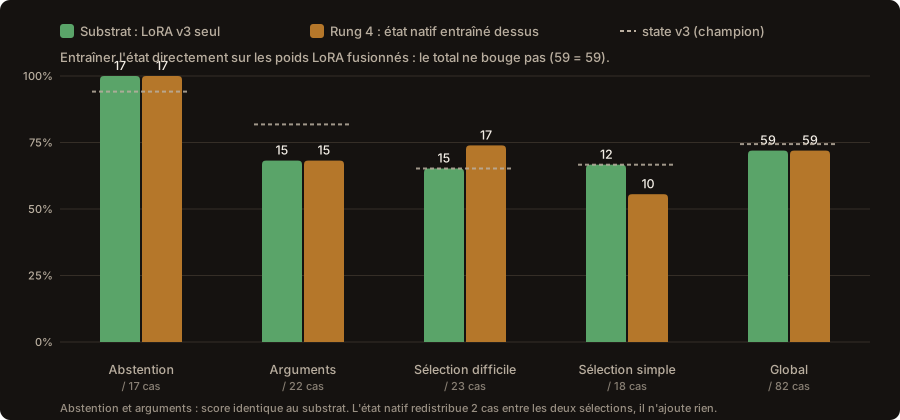
The comparison with the bare substrate closes the argument. LoRA v3 with nothing on top already scores 59/82. With the natively trained state on top: 59/82 as well, same abstention, same arguments, two cases fewer in simple selection and two more in hard selection. The native state does not exceed its substrate, it redistributes.
Conclusion for the "library of skills": composition never collapses, but it does not sum strengths, the substrate imposes its profile. State-tuning alone remains the champion: 61/82, byte-reproducible, 11 MB. A clean negative result, published like everything else: raw generations, scores and recipe in the benchmark repository.
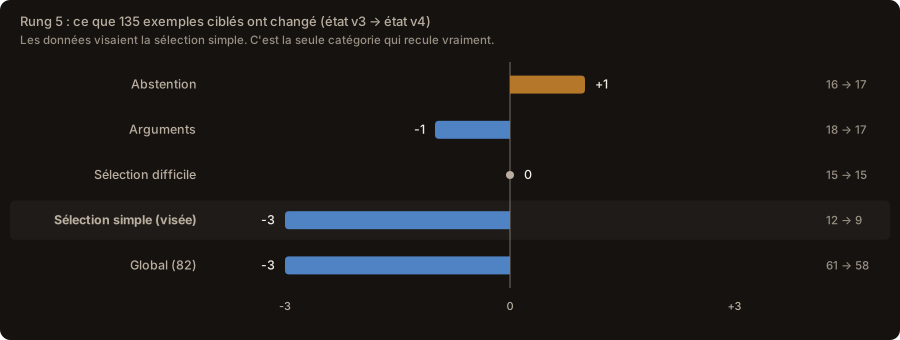
Rung 3 showed that 113 purpose-built examples conquered abstention. Rung 5 asks the symmetric question: does the same surgery work on the champion's weak category, simple selection (12/18)?
Error analysis of the six misses gave three clear failure modes: namespace collisions (linear_search_issues confused with github_search_issues), invented tool names (browser_switch_theme, which does not exist among the 231), and one argument hallucination. Data v4 = v3 + 135 examples aimed exactly at those failures: bidirectional disambiguation, exact-name anchoring, argument minimalism, all schema-validated and leak-filtered against the judge. Same champion recipe, one variable: the data.
Result: 58/82, and zero of the seven targeted cases were fixed. The targeted category is in fact the only one that really drops.
| Category | state v3 | state v4 (targeted data) | delta |
|---|---|---|---|
| Abstention | 16/17 | 17/17 | +1 |
| Arguments | 18/22 | 17/22 | -1 |
| Hard selection | 15/23 | 15/23 | 0 |
| Simple selection (targeted) | 12/18 | 9/18 | -3 |
| Multi-step | 0/2 | 0/2 | 0 |
| Total | 61 | 58 | -3 |
The wrong answers shift instead of correcting. The seven targeted cases, before and after:
| Expected tool | state v3 answer | state v4 answer |
|---|---|---|
runtime_info | model_get_info | model_manage |
set_theme | browser_switch_theme | browser_set_theme |
linear_list_cycles | valkyrie_list_cycles | valkyrie_list_cycles |
tool_result_fetch | consciousness_recall | consciousness_recall |
valkyrie_get_reminders | task_queue_results | valkyrie_list_projects |
linear_search_issues | github_search_issues | web_search |
valkyrie_create_card | hallucinated status_key argument | hallucinated status_key argument |
Four answers out of seven change, three do not move, none becomes right. Elsewhere on the judge, seven previously-passing cases fall into error and four return to the correct tool, a net loss of three. Meanwhile abstention, which is a disposition and not a lookup, reaches 17/17: the state's first perfect score on that category.
The reading that unifies the campaign: an 11 MB initial state moves dispositions (when to abstain, what tone, what format) but cannot pin fine-grained name mappings. It is exactly the lock of the state-as-index collapse we measured before the campaign, when a frozen state proved unable to hold a directory of 231 tools. Four rungs land at 61, 59, 59 and 58: the state family sits at its capacity ceiling, around 60/82 on this judge, and further data curation reshuffles the profile instead of raising it.
The next escalations are verifiable-reward training (GRPO) or more adapter capacity, not more examples.
The rest of the campaign is the subject of a second article: the RL runs, the full map of the ceiling, and its resolution through scale (a state-tuned 7.2B at 69/82, beating the 30B cloud model).
The public benchmark repository: git.scarletwolf.cloud/kevin/rwkv-toolcaller-bench (mirror: Codeberg). It contains: the judge (82 cases), the 231 tool schemas, the evaluation and scoring scripts, the raw generations of every run (including the ones that do not flatter us), the loss curves, the pod-by-pod training recipes, and the SHA-256 fingerprints of the base model and trained states (the 11 MB files are included). The exact environment is pinned: RWKV-PEFT commit, torch and peft versions, Docker image. The cloud reference is qwen3-30b-a3b-instruct-2507 via OpenRouter.
Hardware needed to redo everything: an Ampere-or-newer GPU (bf16 is required by the RWKV-7 training kernels; Kaggle's free T4s cannot run them), about 2 hours, under a dollar.
Sovereignty and economics. An agent's requests carry the user's full working context; processing them locally removes the transfer question entirely. And an RNN serves long sessions at constant memory, where a transformer's KV cache grows with the conversation.
The 82 judge cases do not appear in the training data: 17 are hand-written, 65 were generated by a different model family with a similarity filter, and the judge was frozen before the first measurement. The very low loss (0.05) indicates strong adaptation to the format; the score on these never-seen cases measures generalization.
It is the cheapest rung of the ladder (0.2% of parameters, $0.53) and was planned as a mere plumbing test before a LoRA. It hit the target on its own. The LoRA explored further; see the rung 2 section.
That the skill is a file. Load the base model once, then hot-swap specialized states per task without duplicating the 5.6 GB of weights. That is a deployment model of its own for local agents.
The benchmark repository is public, and so is Gungnir's code. Links are in the Reproduce section. If you find a hole in the protocol, write to us; that is what publishing this is for.
